Commercial Hood Installation Services | Type 1 & Type 2 | DC, MD & VA
Expert design and installation of Type 1 and Type 2 commercial kitchen exhaust hoods across Washington DC, Maryland, and Virginia. CaptiveAire, Accurex, and Greenheck authorized. Permits handled. Call (800) 200-2134.
Express Kitchen Hoods designs and installs Type 1 and Type 2 commercial kitchen exhaust hoods for new restaurants, kitchen renovations, and equipment upgrades throughout Washington DC, Maryland, and Virginia. We are authorized installers for CaptiveAire, Accurex, and Greenheck — and we handle the permitting process. Call (800) 200-2134 or request a free quote.
Type 1 vs. Type 2 Commercial Kitchen Hoods — What's the Difference?
Choosing the correct hood type is a code requirement, not just an equipment preference. The International Mechanical Code (IMC) and NFPA 96 specify which hood type is required based on the cooking equipment being ventilated:
| Hood Type | Required For | What It Removes |
|---|---|---|
| Type 1 | Grease-producing equipment — fryers, griddles, charbroilers, woks, open flame burners, ovens | Grease-laden vapors, smoke, combustion byproducts, heat |
| Type 2 | Non-grease-producing equipment — dishwashers, steamers, ovens without open flame, warming equipment | Heat, steam, condensate, odors |
Installing a Type 2 hood over grease-producing equipment is a code violation and a serious fire hazard. If you are unsure which type your equipment requires, we provide free on-site assessments before quoting any installation.
Brands We Install
We are authorized installers for North America's leading commercial kitchen ventilation manufacturers:
- CaptiveAire — the most widely installed commercial kitchen ventilation system in the US. CaptiveAire hoods are manufactured in the US with industry-leading lead times and full parts availability. We install their full product line including the DCV (demand control ventilation) systems.
- Accurex — premium commercial ventilation manufacturer known for high-efficiency exhaust and dedicated outdoor air (DOAS) make-up air systems.
- Greenheck — commercial and industrial fan and ventilation equipment. We install Greenheck exhaust fans, make-up air units, and supply fans as part of complete kitchen ventilation systems.
- Custom fabrication — for kitchens with non-standard configurations, historic buildings, or unique architectural constraints, we fabricate custom stainless steel hoods to specification.
The Installation Process
A complete commercial hood installation involves multiple coordinated trades and phases. Here's how we manage the process:
- 1. Site assessment and load calculation — we measure your cooking equipment, calculate required exhaust CFM (cubic feet per minute) per NFPA 96 and IMC, and determine duct routing options through your building.
- 2. Hood and duct design — selection of hood model, size, and configuration; duct layout from hood to rooftop; fan sizing; make-up air system sizing.
- 3. Permit drawings and submission — we prepare mechanical permit drawings and submit to the local authority having jurisdiction (DC DOB, Maryland DHCD, Virginia local building department). We handle all permit follow-up.
- 4. Hood fabrication or order — standard CaptiveAire/Accurex/Greenheck units are manufactured to order. Custom stainless hoods are fabricated locally.
- 5. Installation — hood mounting, grease duct installation (welded airtight seams as required by NFPA 96), exhaust fan installation, electrical connections, and make-up air system connection.
- 6. Fire suppression system — we coordinate installation of the required fire suppression system (or install it ourselves) timed to the hood completion.
- 7. Balancing and commissioning — exhaust and make-up air flows are measured and balanced to design specifications; the system is tested before final inspection.
- 8. Permit final inspection — we coordinate with the local authority for mechanical and fire suppression final inspections and provide all required documentation.
Make-Up Air (MUA) Systems
A commercial exhaust system cannot function correctly without a properly sized make-up air system. When your exhaust fan removes air from the kitchen, that air must be replaced — otherwise the hood creates negative pressure, causing back-drafting of combustion appliances, drafty dining rooms, and reduced exhaust performance.
We design and install make-up air systems including:
- Short-circuit supply air (front-face discharge — most common)
- Perforated plenum ceiling supply (for larger kitchens)
- Direct-fired and indirect-fired make-up air units (conditioned MUA)
- Demand Control Ventilation (DCV) — variable speed exhaust and supply that reduces energy use during low-cooking periods
Hood Replacement vs. New Installation
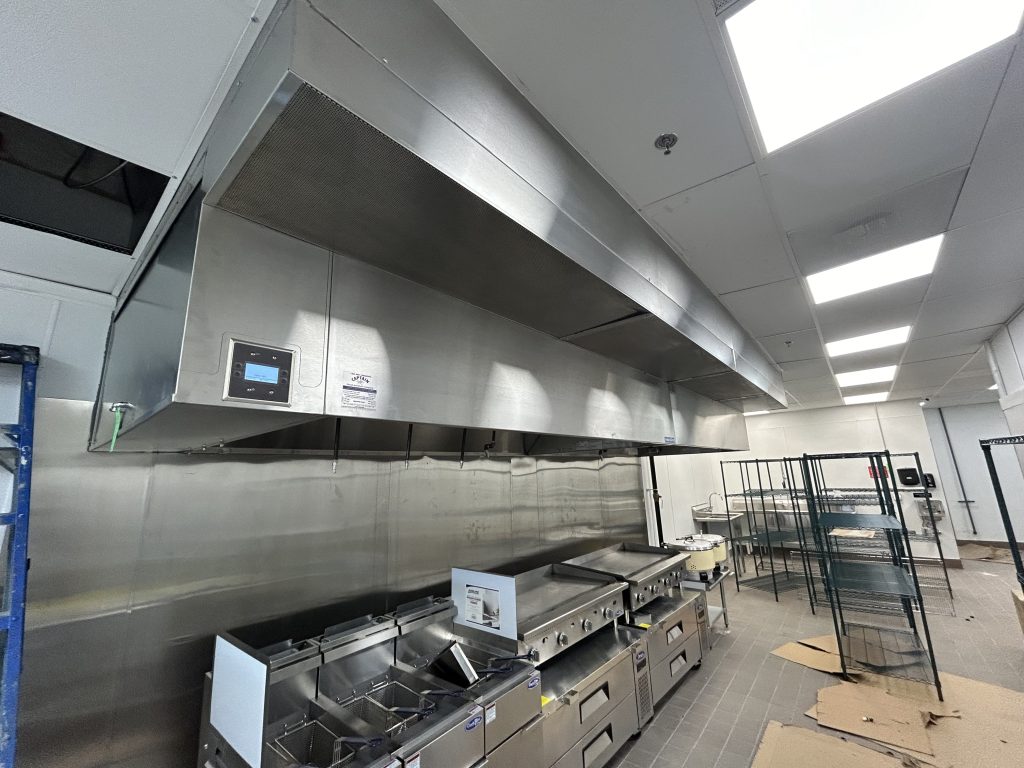
If you are replacing an existing hood rather than starting from scratch, the process is streamlined but still requires permits and inspection in most jurisdictions. We handle hood replacements including:
- Like-for-like hood replacement (same size, same duct connection)
- Hood upsizing when cooking equipment has been added or upgraded
- Conversion from Type 2 to Type 1 when cooking operations have changed
- Replacement of hoods damaged by fire, grease buildup, or structural issues
Service Areas for Hood Installation
We install commercial hoods throughout the DC metro area including Washington DC (all quadrants and neighborhoods), Montgomery County, Prince George's County, Howard County, Anne Arundel County, Baltimore City, Fairfax County, Arlington, Alexandria, Loudoun County, and Prince William County.
Frequently Asked Questions — Commercial Hood Installation
Do I need a permit to install a commercial kitchen hood?
Yes, in virtually all jurisdictions. DC, Maryland, and Virginia all require mechanical permits for commercial kitchen hood installations. The permit process includes plan review and a final inspection by the building department and/or fire marshal. We handle the permit application and drawings as part of our installation service — you do not need to manage the permit process yourself.
How long does a commercial hood installation take?
The timeline depends primarily on permit approval time and equipment lead time. Equipment lead time for standard CaptiveAire models is typically 3-6 weeks. Permit review in DC can take 4-8 weeks; Maryland and Virginia local jurisdictions vary from 1-4 weeks. We begin permit submission as soon as the design is approved, so permitting and fabrication run in parallel. Total project timeline is typically 6-12 weeks from contract to final inspection.
What size hood do I need for my cooking equipment?
Hood sizing depends on the cooking equipment being covered — specifically the equipment's heat output (BTU/hr), the type of cooking (dry heat vs. high-moisture), and the kitchen ceiling height. NFPA 96 requires the hood to overhang the cooking equipment by at least 6 inches on all sides (some configurations require more). We perform a free load calculation and equipment survey before providing a quote.
Can you install a hood in a historic or older building?
Yes. Historic and older buildings in DC, Maryland, and Virginia present common challenges: limited roof access, shared exhaust risers, masonry construction, historic preservation requirements, and restricted duct routing. We have extensive experience designing compliant duct systems that work within building constraints — including horizontal duct runs to alternative exhaust points, enclosed shaft construction, and exterior surface-mounted duct where permitted.
Do you install the fire suppression system as well?
Yes. We install the suppression system as part of the complete hood installation package, or we coordinate with a preferred suppression contractor if you have an existing relationship. Either way, we manage the timing so the suppression system is installed and tested before the permit final inspection. See our fire suppression services page for details.
What is Demand Control Ventilation (DCV) and should I install it?
DCV systems use temperature and opacity sensors to automatically modulate exhaust fan speed — running at full capacity only when the cooking line is active and reducing airflow during idle periods. DCV can reduce kitchen HVAC energy consumption by 30-50%. Many jurisdictions now require DCV for new installations above a certain system size. We can assess whether DCV is required or beneficial for your specific application.
We're opening a new restaurant — when should we start the hood installation process?
As early as possible. The hood is on the critical path of a restaurant buildout — it affects ceiling height, HVAC design, electrical rough-in, and fire suppression. We recommend starting the hood design and permit process as soon as your kitchen layout is finalized, ideally 3-4 months before your target opening date. Call us at (800) 200-2134 for an initial consultation — we can flag any design issues before they become construction delays.
Do you service and clean the hood after installation?
Yes. We offer ongoing hood and duct cleaning and suppression system inspection services after installation. Many clients prefer to use the same company that installed their system for ongoing maintenance — our technicians already know the configuration, duct routing, and access panel locations, which makes each cleaning faster and more thorough.
Get a Hood Installation Quote
CaptiveAire, Accurex & Greenheck authorized — permits handled — DC, Maryland & Virginia.